Computational Couture#
Global Instructor: Julia Körner
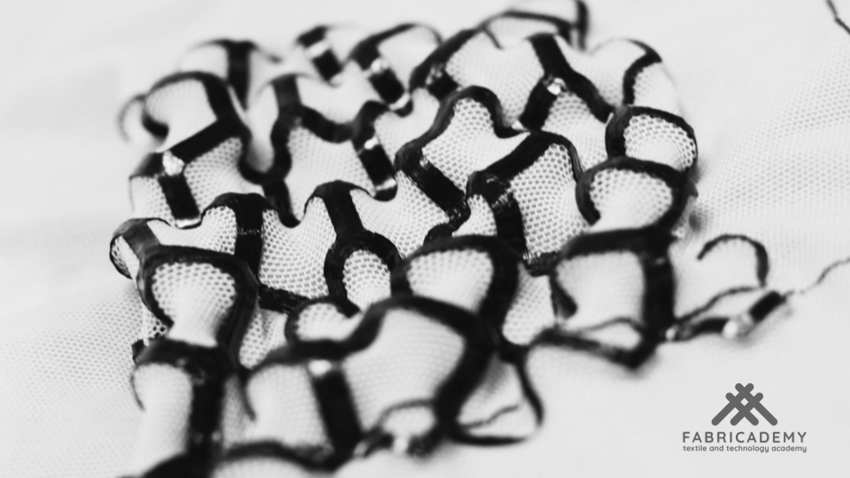
The Computational Couture module explores how computational design reshapes fashion toward adaptive, data-driven systems that enable mass customization, generative, iterative and form-finding design processes. Participants are introduced to parametric 3D modeling and 3D printing technologies, learning about multiple additive manufacturing technologies such as FDM, SLA, SLS and direct-to-garment printing. The module focuses on textile and fashion applications, including 3D printing on fabrics, chainmail and lattice structures, while developing an understanding of fabrication constraints and material opportunities.
Through hands-on prototyping, participants learn file-to-factory workflows, moving from parametric modeling to slicing and additive manufacturing. They build practical skills in preparing printable geometries, optimizing structures and producing functional fashion prototypes. By applying computational design and digital fabrication to fashion and textiles, the module introduces the concept of programmable fashion, bridging couture craftsmanship with emerging technologies and innovative production models.
Program outline#
- Introduction
- Patterns manipulations
- Box Morphing
- Loops and iterations
- Recursive subdivision / localized subdivision
- Physics and simulations
- Wrapping
- Foldable patterns
- Unrolls and mesh planarization
- VR representations
Tools/software#
- Required: 3D Printer FDM
- Optional: SLA, SLS printer
- Rhinoceros 3D
- Grasshopper
Libraries for Grasshopper
- Kangaroo
- Anemone
- Weaverbird
- Cocoon
- Marching Cubes
- Mesh Edit
- Mesh+
- Mesh tools
- Lunchbox
- VR-Edge
- Mesh analysis
Materials#
| Material | Details |
|---|---|
| 3D Printing Spools | PLA, TPU/NINJAFLEX, etc |
| Fabrics | Net, tulle, 2-way stretch, etc |
Assignment#
- Document the concept, sketches, references also to artistic and scientific publications Design a parametric model using Grasshopper3D and uploadthe rhino file + grasshopper files
- Learn how to use 3D printing techniques to print the 3D model in/on the chosen materials
- Document the workflow for exporting your file and preparing the machine and gcode to be 3D printed
- Upload your stl file with pictures at oscircularfashion.com
- Submit some of your swatches to the analog material library of your lab. (20cm *20cm aprox)
Evaluation and assessment#
Check the Assessment Criteria
References#
Fabricademy Tutorials - 3D Printing - 3D Modelling - Grasshopper