Wearables#
Global Instructor: Liza Stark
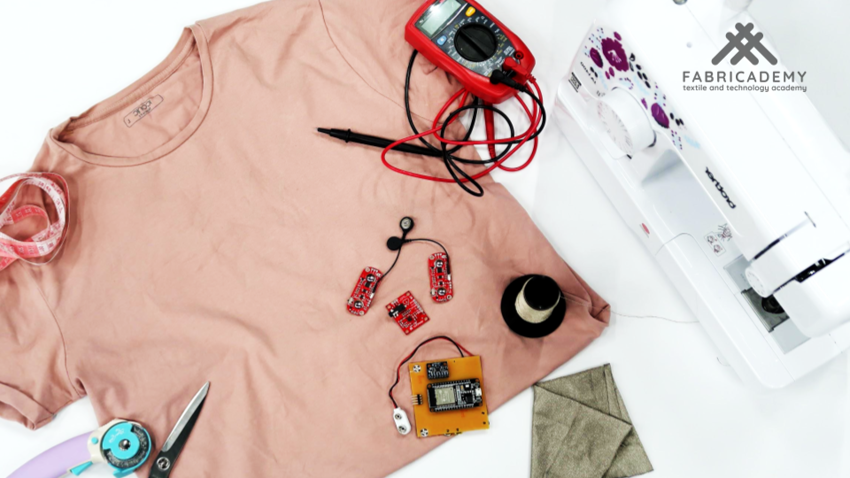
The Wearables class builds upon the E-Textiles module, where participants are introduced to conductive and resistive materials and the foundations of soft circuitry. Expanding on these basics, this class focuses on integrating sensors and actuators into textile systems and explores programming approaches for wearable applications.
Participants learn how garments and textile interfaces can sense, respond and interact with the body and environment, gather their first data from DIY sensors and beyond. They ideate and develop wearable projects that combine electronics, microcontrollers and textile techniques, while considering the boundaries of soft-hard connection in relation to flexible materials. The class encourages experimentation with interactive garments and soft interfaces, connecting textile design with embedded electronics and digital fabrication.
Program Outline#
-
Introduction: What does it mean to be wearable? What factors and variables must we take into consideration?
-
Actuators:
- What are different types of outputs? How do we control them? What are transducers?
- LEDs, Neopixels, Optical fibers
- Thermochromic ink + heated circuit/code
- Sound, Fabric speakers + amplifier circuits/code
-
Motion, Flip dot and Flapping wing, Mini vibration motors#
- ATtiny: Programming, touch/sensor circuit and Sound circuit with stretch sensor
-
Wireless: RF, EMF circuits, Antennas
-
eTextile Tools: create tools to support your practice, Pin probes, Continuity testers, Measuring resistance
- References
Tools/Software#
- Multimeter
- Soldering iron (Soldering station)
- Pliers, wire stripper, flush snips, tweezers
- Mix. Electronics
- Embroidery / Sewing machine / Needles
- Arduino IDE
Materials#
| Material | Details |
|---|---|
| Microcontroller | Arduino, ATtiny, XIAO |
| Fabrics & Threads | resistive/conductive/pressure sensitive |
| Wires | jumpers, alligator clips wires |
| Copper tape | + isulating tape |
| Leds | sewable single neopixels and strips |
| Fiber optical fibers | |
| Motor driver | optional |
| Actuators | mini vibration motors, speakers with amplifier and MP3 player |
| DFPlayer mini + sdcard | mini MP3 module |
| SMA - Shape memory alloy |
Assignment#
- Document your idea , sketches, references and research
- Create a swatch using an attiny with one input and one output of your choice, using hard-soft connection solutions and battery
- Create 2 actuator swatches and test them with the Arduino or ATtiny
- Learn how to program and ATTiny, add the libraries and links you used for your code
- Document the schematic and the programming code, libraries you had to add and calculations
- Upload a small video of your object working
- EXTRA POINT Integrate it to a project
Evaluation and assessment#
Check the Assessment Criteria
References#
Fabricademy Tutorials - Electronics / Wearables
Kobakant - actuators